I’ve never been to Ithaca, New York before, or to an Ivy League college, or spent a whole week in a library! But I’ve done all three in the past week. Some of it was surprising and thrilling. Discovering that Ithaca has a serious housing problem was not. This is the new global pandemic. That’s maybe a metaphor to handle with care, but actually, there are many comparisons. The contagion of global corporate property speculation spreads like a virus – and it’s killing people.
One local told me “Ithaca is a microcosm of America”. It’s relatively small: normal population 30,000, but that doubles during Cornell University term times. Cornell dominates the city, literally and figuratively. It’s on top of a steep hill on the north-east side of town. Walking around the campus, you get an immediate sense of the wealth and privilege associated with Ivy Leage elitism. It’s a sprawling site, peppered with august, imposing buildings that date to the institution’s founding in 1865. A member of staff informed me that no other US university appropriated/stole more land from Native Americans in its establishment. Given this background, it’s probably not surprising that the median family income of a Cornell student is $151,600, approximately three times more than the city’s general population. One in ten of the students come from the nation’s richest 1%.
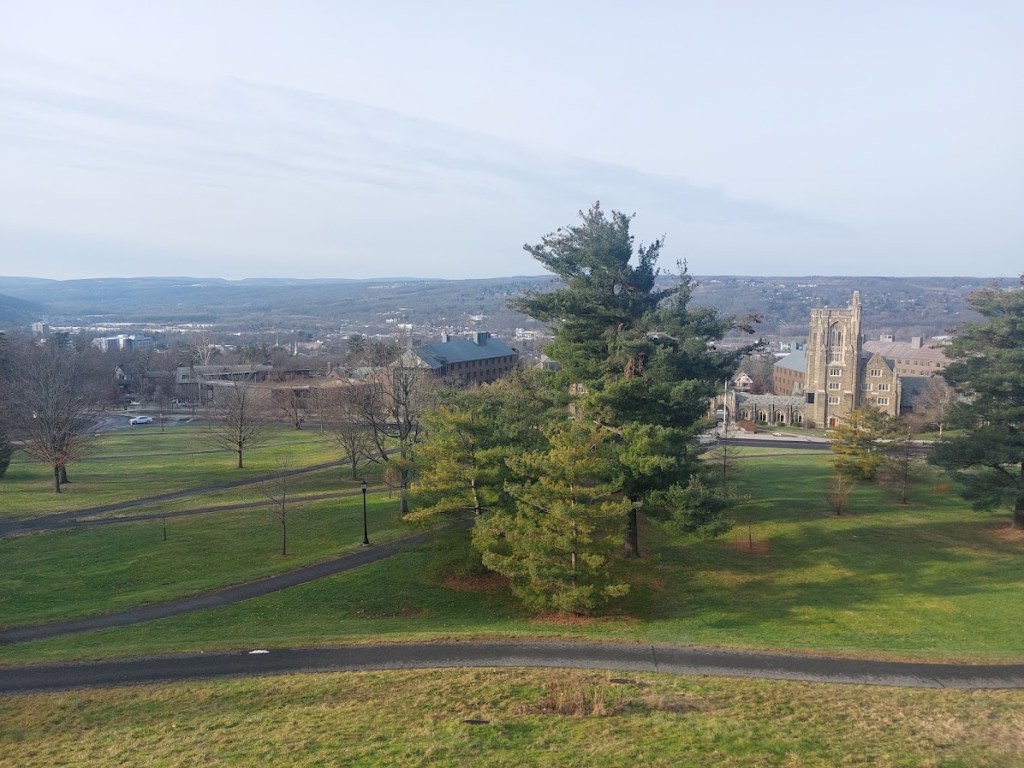
This has a distorting effect on housing. The area immediately around the university is full of homes and apartment blocks aimed at the student market, which the development industry now classifies as an “asset class”. But it’s noticeable that last week, before term started and students returned, many of them appeared empty. Meanwhile, the “other” Ithaca faces a constant and increasing struggle to find an affordable home. The newly elected city mayor is prioritising the issue and it seems Ithaca is doing better than some places in building homes that meet local needs. But there are still familiar problems with the definition of “affordable” and the symptomatic scourge of short-term lets. As ever, there isn’t a one-shot solution. But it might help if Cornell University started paying property taxes, from which, like similarly affluent educational institutions elsewhere in the US and the UK, it is exempt.
However, in another twist in the endless contradictions of this nation, Cornell also holds a unique collection of material from the labour movement, particularly the unions of the textile industry, which is what brought me here. I’m researching the life, time and works of Abraham E Kazan, a pioneer of co-op housing in New York City (more to follow) and – partly thanks to a grant from the Society for the Study of Labour History – had a chance to trawl the archives of the International Ladies Garment Workers Union (ILGWU) and the Amalgamated Clothing Workers of America (ACWA), while handling letters bearing the signatures of Clarence Darrow, A. Philip Randolph and Eleanor Roosevelt.
I had an invitation to talk about my research with fellow trade unionists, housing activists and others at, fittingly, EcoVillage, a housing co-operative just outside town. I’ve never bene to a place quite like that before either, but it was a reminder of the utopian impulse that has been a constant feature, sometimes very warped, of this country since European colonisation – and it endures in different forms. Apparently, Ithaca is experiencing a population spike (which will also fuel house prices) because people are moving here as “eco refugees”. Unlike many other parts of the US, this area is not under the growing threat of floods, forest fires or draught.
Cornell presents a stark contrast with the “The Jungle”, a long-established encampment of homeless people on the south-west of Ithaca. Such places have a long history in this country: indeed, you could argue the nation was founded as a homeless encampment! But from the Hoovervilles of the Great Depression, to the Obamavilles of the Great Recession, these places stand as a sign of a divided society. The Ithaca Jungle takes a particularly 21st century form. It’s located behind one of the ubiquitous Big Box retail parks that disfigure this country. To be removed from the culture of consumerism feels like the contemporary equivalent of the lepper colony. There’s a tragic irony that some of the concern about The Jungle is that its residents have a habit of stealing shopping trolleys, the eighth deadly sin!
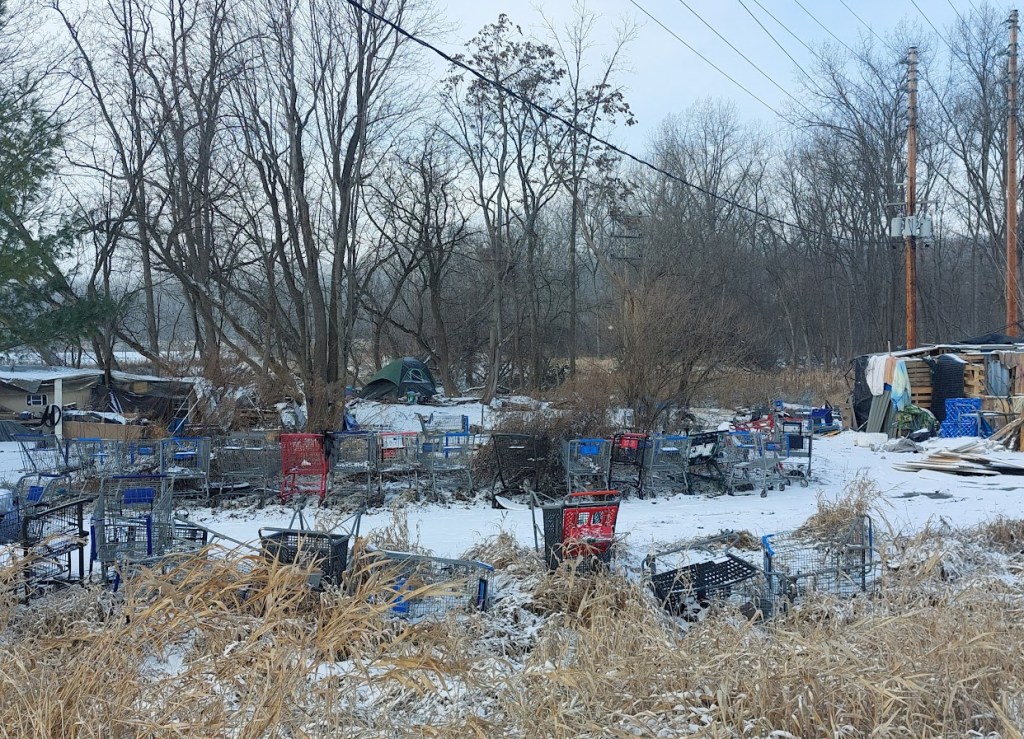
I gather from locals that The Jungle has been growing – unsurprising, given the city’s housing situation – and I’ve picked up several references to it being the source of anxiety and fear. Herein lies one of the most significant features of contemporary America, particularly in an election year. The Jungle embodies a host of deep-rooted troubles, including the menace of opioid addiction, a form of social murder that continues to ravage the country, to the point that one local said to me “if we had another heroine epidemic, it would be progress”.
Of course, there is an axiomatic link between housing scarcity and precarity and self-destructive addictive behaviour. At the risk of sounding facile, it’s very hard to live a good life, if you haven’t got a good home. Some local authorities, including Ithaca, are coming to understand this through “Housing First” strategies that seek to provide suitable accommodation, as a precursor to other forms of support. That makes sense, although such policies aren’t, in themselves, capable of subverting the inherent iniquity and volatility of the capitalist housing model. But I’m often reminded of John, someone I knew on the council estate where I worked for many years. He was an alcoholic, but – almost miraculously – had been allocated a one-bedroom council flat. I talked to him about this turn in his life and he was quite clear that, while he definitely needed help with his addiction, what he needed before that was a truly affordable, secure home.
As I write this, 24-hour news is gripped by the Iowa Caucus, effectively the start of the 2024 Presidential election. I watched, through my fingers, one of the “debates” between two of the Not Trump candidates. Embarrassing. One person interviewed afterwards was asked if he was any clearer about who he would vote for in November. He replied, “I’m waiting for a sign”. Thus speaks America.
Closing – and briefly in Tour Guide mode – Ithaca is great! The people I met were really friendly, it’s easy to get there by Cornell bus from New York City (here – you don’t have to be a student or academic and it’s a spectacular ride), it has a brilliant anarchist-run book shop (here), an excellent curry house (here) and one of the best bars – and I’ve visited a few! – I’ve ever been to (here).
Finally, like almost everywhere, Ithaca needs a vaccine for the housing pandemic. Unlike COVID, this isn’t something that has to be discovered for the first time. There are examples all around us of housing solutions that have worked. But as with coronavirus, finding a cure can’t be left to the profit-addicted forces that are the cause.
 The View from K92
Leave a comment